The academic landscape in 2026 has shifted. We are no longer just “studying”; we are competing with algorithmic precision, lightning-fast information cycles, and a digital environment that eats our attention spans for breakfast. If you’ve been pulling all-nighters, fueled by caffeine and pure panic, only to see your GPA stagnate, it’s time for a reality check. Your current study routine isn’t just tired—it’s actually coded for failure.
The “hustle culture” of simply sitting at a desk for ten hours doesn’t work anymore. True academic “aura” isn’t about looking busy; it’s about having the quiet confidence that comes from efficiency and high-level output. To truly level up, many students are realizing that they can’t do it all alone. This is where professional support systems come in. Integrating a reliable assignment writing service into your broader academic strategy is a pro-move used by top-tier students to understand complex structures and meet high-level university rubrics without losing their sanity.
Why Your “Grind” is Actually “Brain Rot”
Most undergraduate routines are built on outdated 20th-century models. You sit down, open a laptop, and hope for the best. But without a specific framework, you’re just inviting “brain rot”—that state where you stare at a screen for three hours and accomplish absolutely nothing.
The Passive Learning Trap
Reading your notes over and over is the biggest lie in education. It feels like work, but it’s passive. Your brain isn’t actually “saving” the file; it’s just recognizing the text. To “aura-max” your grades, you need active recall. If you aren’t testing yourself every 20 minutes, you aren’t learning.
The Multitasking Myth
You think you can “lock in” while having a Discord stream on one monitor and a lecture on the other. You can’t. Every time you switch tasks, your brain pays a “switching cost.” It takes nearly 20 minutes to reach deep focus again. By the time you’re back in the zone, you’ve already checked your phone three more times.
The 2026 “Peak Performance” Framework
To stay ahead, you need a routine that respects your biology and your time. Here is how high-achievers are actually structuring their weeks.
1. The Power of “Time-Blocking” (Not To-Do Lists)
To-do lists are stressful because they never end. Time blocks are finite. You decide that from 2:00 PM to 4:00 PM, you are doing only Macroeconomics. When the clock hits 4:00, you stop. This creates a sense of urgency that forces your brain to focus.
2. High-Yield Resource Allocation
Sometimes, the workload is simply mathematically impossible. Between part-time jobs, social lives, and five different modules, something has to give. Instead of turning in a “cooked” paper that ruins your average, smart students find ways to outsource the stress. For instance, when the deadline is 48 hours away and the research isn’t even started, the decision to buy assignment online via Myassignmenthelp becomes a tactical move. It’s about managing your “academic energy” so you can focus on the exams that carry the most weight.
3. The “Second Brain” Method
Stop trying to remember everything. Use Notion, Obsidian, or even a simple physical planner to offload your thoughts. Your brain is for processing ideas, not storing them.
Comparison: Mid-Tier vs. Peak-Tier Study Habits
| Feature | Mid-Tier (Coded for Failure) | Peak-Tier (Aura-Maxxing) |
| Study Environment | Bed or messy desk | Dedicated, distraction-free zone |
| Note Taking | Transcribing every word | Summarizing & Connecting ideas |
| Research | Random Google searches | Peer-reviewed journals & expert help |
| Break Style | Scrolling TikTok (increases fatigue) | Movement or hydration (resets brain) |
| Deadlines | Last-minute panic | Early drafting & strategic outsourcing |
Mastering the “Deep Work” State
“Deep Work” is a term coined by Cal Newport, but for Gen Z, we call it being “locked in.” It is the ability to focus without distraction on a cognitively demanding task. It’s a superpower in 2026 because almost no one can do it anymore.
How to Trigger the “Lock In”
- Physical Cues: Wear a specific pair of headphones or go to a specific floor of the library. Tell your brain, “When we are here, we work.”
- Digital Hygiene: Use apps that lock your social media. If you can’t trust yourself, let the software do the gatekeeping for you.
- The 5-Minute Rule: If you’re procrastinating, tell yourself you’ll only work for five minutes. Usually, the hardest part is the start. Once the momentum kicks in, the “brain rot” vanishes.
Collaborative Success
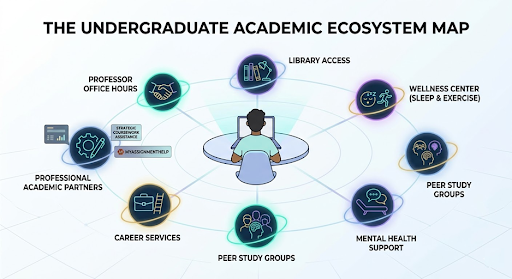
No CEO runs a company alone, and no top-tier student gets through a degree without resources. Whether it’s study groups, office hours with professors, or using professional writing platforms, collaboration is the secret sauce. Utilizing services like Myassignmenthelp isn’t about “taking the easy way out”—it’s about expert-level resource management. It allows you to see how a professional would tackle a complex brief, which in turn improves your own writing “aura” for future tasks.
The Role of Health in Academic Aura
You cannot “max” your grades if your body is failing. Sleep is the ultimate performance enhancer. During sleep, your brain literally flushes out metabolic waste and solidifies what you learned that day. Pulling an all-nighter is like trying to run a marathon with a broken leg; you might finish, but the damage is massive.
- Hydration: Your brain is 75% water. Even 2% dehydration causes a significant drop in concentration.
- Sunlight: Getting 10 minutes of morning sunlight regulates your circadian rhythm, making it easier to focus during the day and sleep at night.
Final Verdict: Is Your Routine Coded for Success?
If you continue to use the same frantic, unorganized methods, you will continue to get the same mediocre results. “Aura-maxxing” your grades requires a total system reboot. It requires you to be honest about where you are wasting time and where you need professional support.
By combining deep focus, physical health, and strategic tools like Myassignmenthelp, you move from being a student who is “struggling to survive” to a student who is “dominating the curve.” Don’t let your degree be a source of constant “L’s.” Upgrade your routine, protect your mental energy, and start winning.
Frequently Asked Questions (FAQ)
Q: How do I know if my study routine is actually failing?
A: If you feel exhausted but your grades aren’t moving, or if you find yourself “panic-working” right before every deadline, your system is inefficient. High-achievers usually have a “calm” approach because they plan ahead.
Q: Is it “cheating” to use academic support services?
A: Not at all. Using services like Myassignmenthelp is a form of supplemental learning. It provides you with a high-quality reference point or “model paper” that helps you understand how to hit specific marking criteria that professors often leave vague.
Q: What is the most effective study technique for 2026?
A: Active Recall combined with Spaced Repetition. Use flashcards (like Anki) and try to explain complex concepts to a friend (The Feynman Technique). If you can’t explain it simply, you don’t understand it yet.
Q: How many hours should an undergraduate study per day?
A: Quality over quantity. Four hours of “Deep Work” is more effective than twelve hours of “Fake Work” (sitting with a laptop while distracted). Aim for 3-5 hours of intense, focused sessions.
Q: How can I improve my academic writing quickly?
A: Read high-level journals and professional samples. Seeing how experts structure arguments, cite sources, and maintain a formal tone is the fastest way to “copy” their success into your own work.
About The Author: Henry Alessi
As a dedicated academic strategist and lead content consultant at MyAssignmentHelp, I specialize in helping university students navigate the increasingly complex world of higher education. With over a decade of experience in educational research and SEO-driven content strategy, my mission is to bridge the gap between rigorous academic standards and accessible, actionable student advice.